
Agent Skills
Agent Skills for Transcripts and Research
Agent Skills package the capabilities of transcript.im as instructions an agent loads on demand. A skill teaches the agent when to reach for a transcript, which tool to call, and what a good result looks like. Skills call the transcript.im MCP server when it is configured and fall back to the REST API when it is not, so the same pack works across Claude Code, Cursor, Codex, Copilot, Gemini CLI, and other Agent Skills runtimes without a per-tool rewrite.
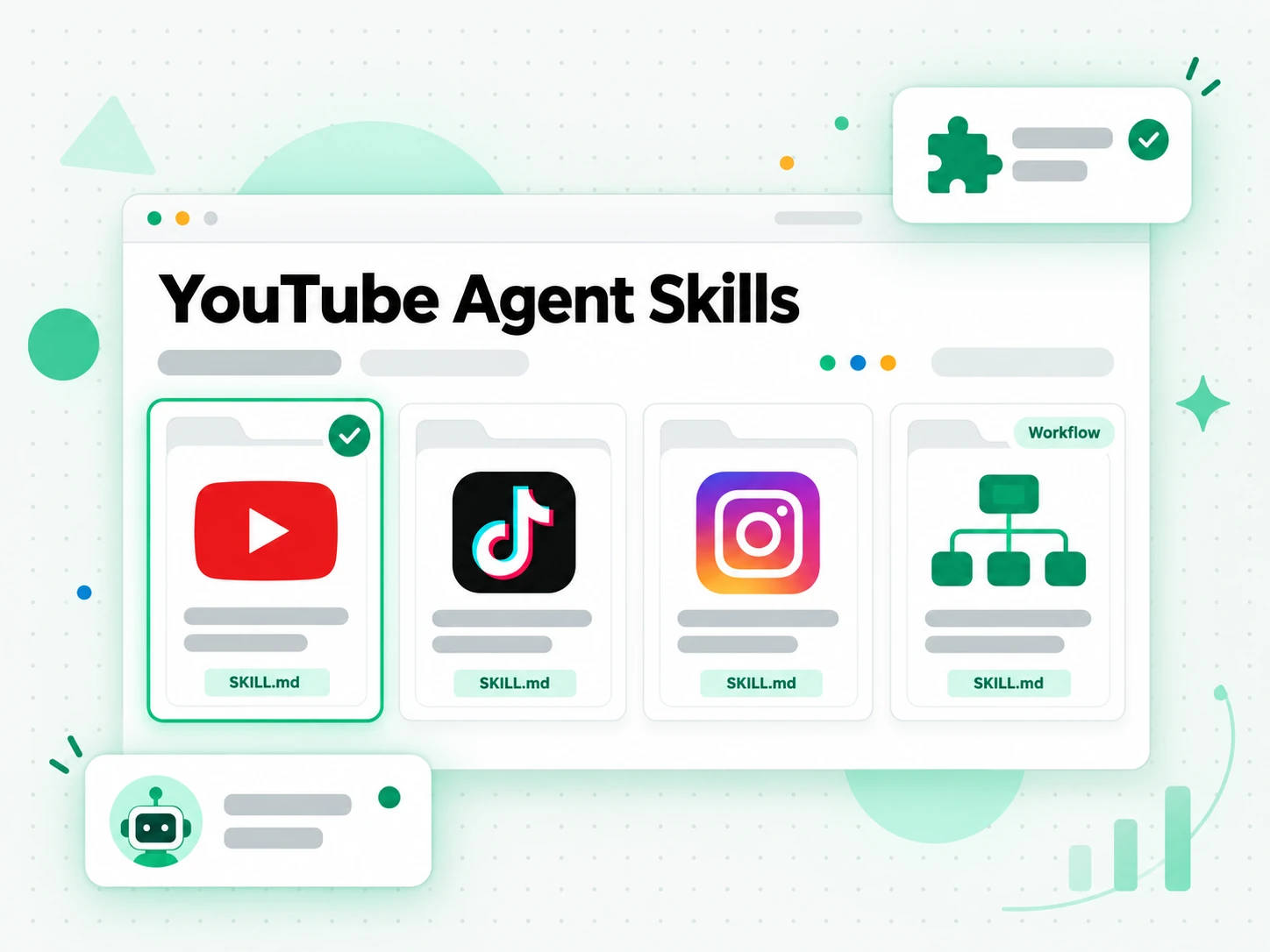
- Three platform packs — YouTube, TikTok, and Instagram — plus a workflow pack for cross-platform research and writing.
- Skills call the transcript.im MCP server first and fall back to the REST API with the same key.
- Transcripts cover YouTube, TikTok, Instagram, LinkedIn, and Twitter/X. YouTube discovery adds search, channels, uploads, playlists, and caption metadata on top.
- Workflow skills return artifacts — briefs, notes, and repurposed content — with source citations.
- Each pack is plain
SKILL.mdfiles, so it loads in any runtime that supports the Agent Skills format.
What Are transcript.im Agent Skills?
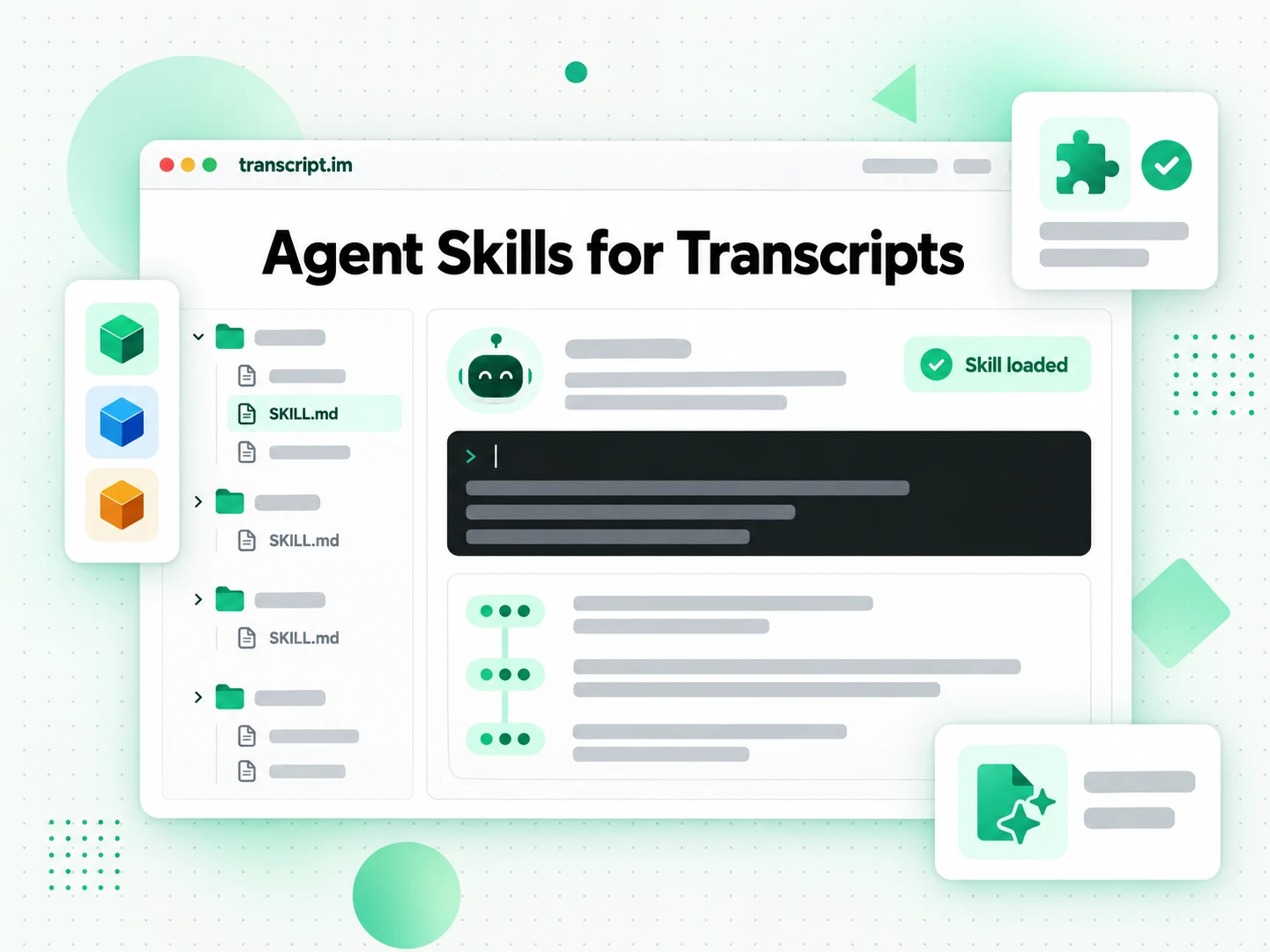
Agent Skills are plain SKILL.md files that describe a capability in the language an agent already understands: when to use it, what to call, and what to return. transcript.im maintains a set of these skills so a coding agent can work with video transcripts without a bespoke integration for every platform.
- Instructions, not infrastructure — a skill teaches the agent what to do; transcript.im does the extraction.
- Platform packs and workflow packs — a pack for YouTube, TikTok, and Instagram, plus skills for multi-step research and writing.
- MCP first, REST fallback — the skill prefers the MCP server and reaches the REST API when MCP is unavailable.
- Artifacts with citations — workflow skills keep the source link and verbatim wording attached to what they produce.
Platform Skill Packs
Dedicated packs cover YouTube, TikTok, and Instagram. Transcript extraction reaches all five platforms the API supports; the discovery skills — search, channels, uploads, playlists, and caption metadata — are YouTube-only, because that is the platform the public API exposes discovery for.
YouTube Skills
The broadest pack. It covers transcripts with or without timestamps, plus the YouTube discovery surface: video and channel search, channel resolution, channel uploads, playlist items, and caption metadata, with a full entry skill that bundles them. youtube-transcript and youtube-api are alias entries for the common ways people phrase the request, so the agent still activates when a user says "YouTube transcript" or "YouTube API".
TikTok Skills
TikTok skills focus on the transcript: captions are read first, and speech recognition covers a video that has none. Paste a TikTok link and the agent returns clean, timestamped text it can quote, translate, or repurpose. Because the skill knows when a transcript is the right answer, it loads for a pasted link even when the user never says the word transcript.
Instagram Skills
Instagram has no caption track to read, so its skills are built around asynchronous speech recognition. The reel and transcript skills turn a public Reel or video post into timestamped text, and a full entry skill bundles the pack. The agent submits the link and polls the job while it works on something else, then returns the finished text.
Workflow Skills That Produce Artifacts
Transcript Intelligence
Summarize and mine transcripts from YouTube, TikTok, Instagram, LinkedIn, or Twitter/X into a report with summaries, key points, verbatim quotes, hooks, and reusable content atoms, each tied to its source. Instead of reading an hour of footage, you get the argument, the evidence, and the lines worth reusing in one pass.
Competitor Research
Compare competitors or creators across the videos you bring, find what is working in a niche, and benchmark topics, formats, hooks, and talking points. YouTube discovery supplies the channel and playlist sweeps; other platforms contribute the transcripts you point it at. The output is a cited competitor brief, so a claim can be traced back to the video and the moment it was said.
Content Repurposing
Turn transcripts or research into reusable content: blog posts, X/Twitter threads, short-form video scripts, newsletters, and a content calendar, delivered as ready-to-edit drafts with source attribution. The draft keeps the speaker's wording where it matters, so the result sounds like the source rather than a generic summary.
- Meeting notes — decisions, action items with owners, open questions, risks, and quotes from a meeting or call transcript.
- Lecture notes — structured study notes, definitions, key arguments, examples, and review questions from a lecture or tutorial.
- Transcript API routing — the data-layer skill every workflow calls to fetch a transcript, run a batch, or discover YouTube videos, channels, and playlists.
How a Skill Reaches transcript.im
A skill never talks to a platform directly. It reaches transcript.im, and transcript.im handles the source.
- MCP first — when the transcript.im MCP server is configured, the skill calls its tools directly and gets structured results back.
- REST fallback — without MCP, the skill calls the same REST endpoints with the same API key, so behavior does not depend on the runtime supporting MCP.
- One credential — the key is read from the environment or the agent's MCP configuration, so the skill does not manage its own secrets or ask the user for a second login.
- Same account — a call made through a skill lands on the same account and history as a call made from the API or the product itself.
- Portable packs — because the routing lives in the skill, the same pack moves between runtimes without a code change.
What a Pack Contains
Each pack is a set of SKILL.md files: one full entry skill that bundles the pack's skills, plus focused sub-skills an agent can load on their own. Because a pack follows the Agent Skills format, it can sit in an agent's skills directory alongside the other skills you already use, and the entry skill still knows when to hand off to the narrower ones.
- YouTube — a full entry skill plus transcript, search, channel, playlist, and caption skills, with
youtube-transcriptandyoutube-apialias entries. - TikTok — a full entry skill plus a transcript skill and its alias, focused on captions-first extraction with speech recognition as the fallback.
- Instagram — a full entry skill plus
reelandtranscriptskills built around asynchronous speech recognition. - Workflow — the
transcript-apirouting skill plus intelligence, competitor research, content repurposing, meeting notes, and lecture notes.
Runtimes That Load These Skills
Skills follow the Agent Skills convention, so any runtime that reads that format can load them. That includes Claude Code, Cursor, Codex, GitHub Copilot, Gemini CLI, Windsurf, OpenClaw, and Hermes Agent, among others. A skill is a folder of Markdown and small scripts, not a plugin binary, so nothing has to be compiled for a new runtime and a pack written for one runtime carries over when you switch. The practical effect is that the same transcript workflow follows you between tools instead of being tied to whichever assistant you set up first, and you do not maintain a separate integration for each one.
Related
Agent Skills FAQs
What are transcript.im Agent Skills?
transcript.im Agent Skills are SKILL.md packs that teach an AI agent when and how to use transcript.im to fetch transcripts, run batches, discover YouTube videos, and produce research artifacts.
Which agent runtimes can load these skills?
Any runtime that supports the Agent Skills format, including Claude Code, Cursor, Codex, GitHub Copilot, Gemini CLI, Windsurf, OpenClaw, and Hermes Agent.
Do the skills require the MCP server?
No. A skill calls the MCP server when it is configured and otherwise reaches the same REST API directly with the same API key.
Which platforms do the Agent Skills cover?
There are dedicated packs for YouTube, TikTok, and Instagram, plus a workflow collection that works across YouTube, TikTok, Instagram, LinkedIn, and Twitter/X. Transcript extraction covers all five platforms; YouTube discovery adds search, channels, uploads, playlists, and caption metadata.
What can the workflow skills produce?
The workflow skills produce intelligence reports, cited competitor briefs, repurposed content drafts, meeting notes, and lecture notes, each keeping its source citations.
How is a transcript skill pack organized?
Each pack ships one full entry skill plus focused sub-skills, so an agent can activate the whole platform or just the piece a task needs.
How does a skill authenticate with transcript.im?
The skill reads an API key from the environment or the agent's MCP configuration and sends it to transcript.im, so a call through a skill uses the same account as a direct API call.
Can I write my own workflow skill on top of transcript.im?
Yes. The packs are plain SKILL.md files with small helper scripts, so you can write a skill in the same format, describe when it should load, and run it alongside the platform packs.
Give your agent transcript skills
Add a platform pack or the workflow pack to your agent, supply an API key, and let it fetch the transcript.